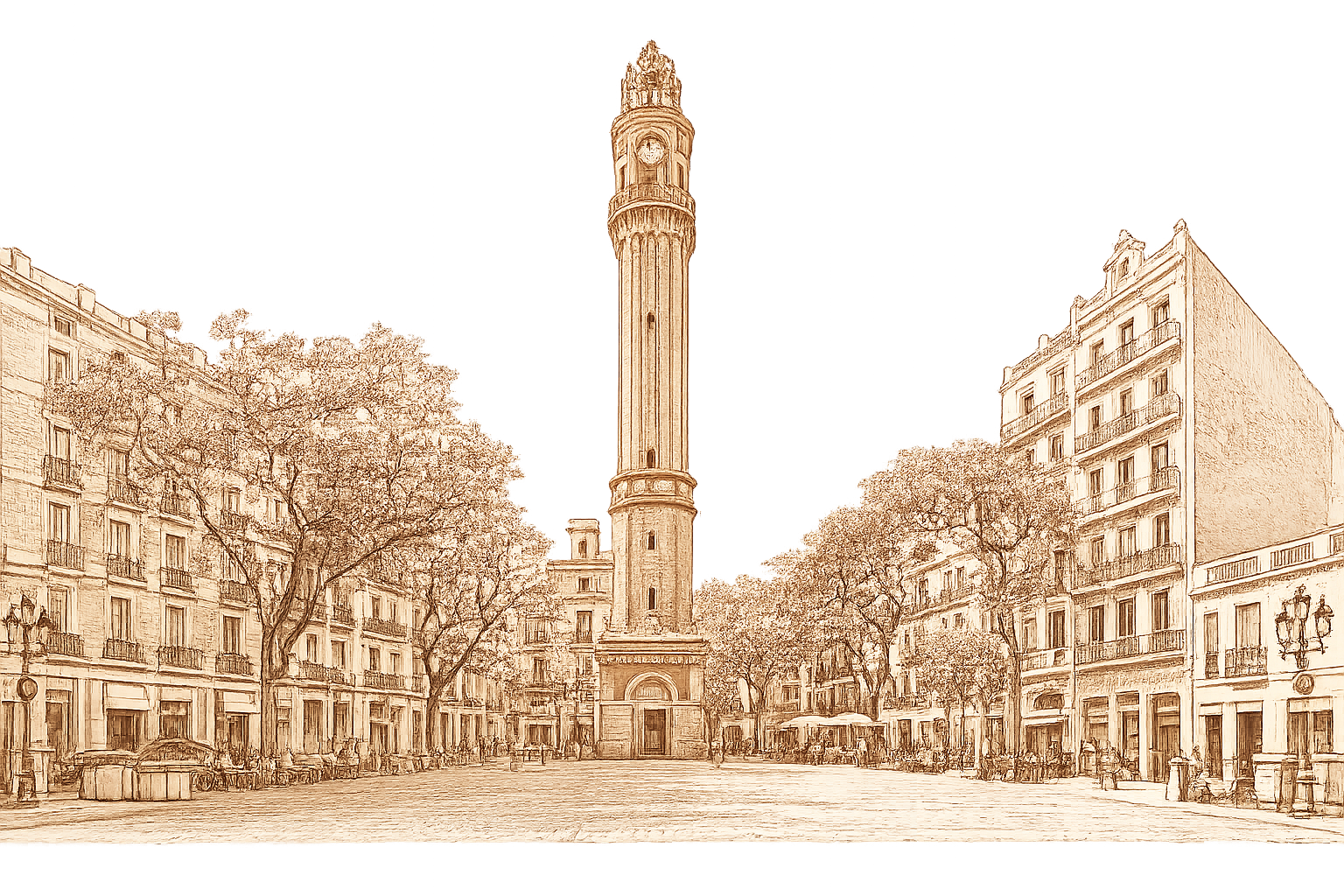
The Independent Village
Gràcia was, like Sarrià, an independent municipality before its annexation by Barcelona in 1897. Unlike Sarrià, it has never stopped fighting for its identity. The neighbourhood's residents have a reputation — earned — for civic engagement, cultural independence, and a particular pride in the character of their streets. The annexation was accomplished; the independent spirit was not.
The physical evidence of this is everywhere. Gràcia's streets are narrower than the Eixample's, the blocks smaller and more irregular, the buildings lower. This is a neighbourhood that grew organically over centuries rather than being planned by an engineer with an ideology, and it shows: the texture is fundamentally different from the rest of Barcelona — less legible, more surprising, more interesting to inhabit over time. You learn Gràcia differently from the way you learn the Eixample. It requires time, repetition, the accumulation of small discoveries.
The Squares
The squares are the key to its social structure. Gràcia has more notable public squares per square kilometre than almost any neighbourhood in the city, and they function genuinely rather than decoratively. Plaça del Sol is where the neighbourhood gathers: morning coffee, afternoon vermouth, evening conversations that extend well past what they should. Plaça de la Vila de Gràcia is more formal and more local — fewer tourists, better afternoon light. Plaça de la Virreina, quieter and more residential, is where families come in the evening. These are not designed social spaces. They are social spaces that have been used for long enough to have genuine character.
The Festa Major de Gràcia — held for a week every August — is one of the most extraordinary popular festivals in Europe, and it is worth understanding as a statement of the neighbourhood's values. Each street elects a committee, raises funds, and decorates itself entirely according to a chosen theme. The competition is real, the level of craft remarkable, and the scale enormous. The neighbourhood does it not for tourism but for itself — the fact that hundreds of thousands of people come to see it is incidental. This is a neighbourhood that does not perform its identity for an external audience. It expresses it.
Culture and Commerce
Park Güell — Gaudí's hilltop park commissioned by Eusebi Güell as a residential development that was never completed and given to the city in 1922 — is extraordinary in conception and execution. The main terrace with its serpentine mosaic bench, the Doric colonnade hall, and the two gingerbread gatehouses at the entrance are among the most photographed structures in the world. The experience of the park is heavily dependent on timing: in peak summer, the protected zone requires timed tickets and the queue is considerable. In winter on a weekday morning, it is possible to walk through in something approaching solitude. The less-visited upper sections — the network of viaducts and covered walkways through the hillside — are almost always quiet and reward the effort of finding them.
Casa Vicens, on Carrer de les Carolines, is Gaudí's first major commission and one of his least visited. Built between 1883 and 1885, it is a student work of extraordinary self-assurance — ceramic-tiled facades, intricate ironwork, interior spaces that already show the spatial mastery that would define his entire career. It opened to the public in 2017 and deserves significantly more attention than it currently receives.
The neighbourhood's commercial street, Carrer de Verdi, is lined with independent bookshops, the Cinemes Verdi (a five-screen independent cinema in original version since the 1970s), and restaurants that have been there for decades. The Mercat de l'Abaceria on Travessera de Gràcia is a genuine neighbourhood market. This is not an area of chain businesses or tourist-facing enterprises.
The Property Market
Property in Gràcia presents different considerations from the Eixample. Buildings are generally smaller — four or five storeys — and the apartments more intimate in scale. Light requires attention: the narrower streets mean that some north-facing apartments on rear courtyards receive very little natural light. Orientation matters more here than in the Eixample's wider grid. The best apartments — upper floors with good orientation, terraces, or roof access — command values that reflect their rarity in a neighbourhood of this character. Ground and lower floor apartments on narrow streets represent a genuine, knowable trade-off: less light, more accessibility, a different relationship with the street.
Buyers here are not looking for grandeur. They are looking for a neighbourhood that feels like it belongs to the people who live in it, and they are willing to accept the physical constraints that come with that understanding.